The mountain is calling: How parking management helps mountain railways achieve revenue and satisfied customers

Mountain lifts play a major role in alpine regions. In winter and in summer alike, they bring large numbers of holidaymakers to a wide range of tourist attractions – skiing, snowboarding, hiking, climbing and the idyllic mountain restaurants. They are also indispensable partners for hotels and holiday apartments, restaurants, shops and other businesses, because they form a key part of the infrastructure and without them hiking and snow sports tourism would not be possible. Yet the parking situation and the parking management at mountain lifts are often far from optimal, resulting in inefficient use of space, dissatisfied customers, a heavy workload and the costs that come with it. This article explains how to master these challenges and what digital parking management offers cableways and entire mountain regions.
Challenges for mountain lift operators
Mountain lift operators are essential to tourism in alpine regions. But they face significant challenges, particularly when it comes to parking management. Those challenges often relate to the parking spaces available, the commercial performance of the site, a high number of unauthorised parkers and the lack of enforcement. The main obstacles are outlined briefly below.
High demand and pressure
With large numbers of holiday guests in high season and only limited parking capacity, cableways and their car parks are often extremely busy – usually at the familiar peak times. This creates pressure in the parking traffic and long waiting times at ticket and pay machines. If the search for a space is not organised on top of that, and the allocation of spaces is unclear to guests, the time spent in the car park increases, along with visitors' stress and frustration.
No commercial model
Parking areas are often provided free of charge. This is the simplest way to run a car park, because it requires very little effort. Other operators opt for a semi-commercial model in which the parking areas are only chargeable at certain times. Both approaches share the same drawback: little or no money is taken in for the upkeep and maintenance of the parking site and the parking technology. As a result, many of these sites are not operated profitably and do not generate the revenue needed to cover maintenance or modernisation.
Occupied parking spaces
Challenges also arise from car park users who occupy spaces for long periods, or who use the car park but not the mountain lift. Examples include ski tourers, whose numbers keep rising as the sport grows in popularity, but also campers and long-term parkers. If the parking areas are not monitored, these groups of visitors use the spaces for as long as they like and block them for mountain lift users without generating any revenue. That prevents additional income for mountain lift operators, who lose potential paying customers because the parking areas are not available to lift users. In most cases there is no enforcement or follow-up of outside parkers because the capacity is simply not there. For more information on how to avoid unauthorised parking, see the blog article avoiding unauthorised parking.
No optimal parking process
For chargeable and free car parks for cableway users alike, refunds, payment and proof of payment are often lengthy and sometimes unclear. The procedures differ from operator to operator, which can confuse some guests. The processes for free parking – particularly refunds and proof of payment – are often cumbersome and error-prone as well: whether the parking ticket has to be placed behind the windscreen or redeemed after the trip, it can get lost or fail to be properly visible. Faulty barriers and pay machine outages can also cause delays and, with them, frustration for guests and operators.
{{contact}}
The solution: efficient parking management for mountain lifts
Inefficient use of parking areas, outside parkers and an error-prone parking process significantly reduce the revenue potential and profitability of a site. A digitalised parking management concept resolves this challenge, optimising revenue and reducing costs at the same time.
The potential unlocked by digitalising processes has been reaching the parking industry for several years now. Digital parking management opens the door to more efficient processes and to fully realising the optimisation potential within the shift in mobility. It combines automatic number plate recognition – ANPR technology – with digital parking management. With ANPR, vehicle licence plates are captured automatically and in compliance with data protection law on entry and exit, and can be managed through integrated software. Providers such as Peter Park also cover many other aspects of operation with their digital platforms, for example managing maximum parking times and parking permissions. For mountain lift operators, the software makes parking management easier, because processes such as administration, payment, analysis and enforcement of parking areas run automatically through licence plate recognition. Some providers additionally handle the follow-up of unauthorised parkers, which is often very time-consuming and unpleasant for operators. This service makes operations easier still for mountain lift operators by reducing internal effort and keeping the parking areas free for their own customers.
What are the benefits of digital parking management?
Benefits for mountain lifts
Higher revenue potential and lower maintenance costs
Digital parking management gives cableway operators the opportunity to generate new sources of income. Pricing models can be tailored to specific customer groups and implemented accordingly. If a service including follow-up of unauthorised parkers is chosen as well, outside parkers are avoided without additional cost or staff effort, and the follow-up generates additional revenue. Because parking management runs twenty-four hours a day, seven days a week – including outside cableway operating hours – this can also increase revenue. On top of that, costs for maintenance, repairs, enforcement staff and downtime caused by faulty barriers or ticket machines are eliminated, because ANPR technology and digital management make barriers and tickets unnecessary.
All parking data visible in a single, simple dashboard
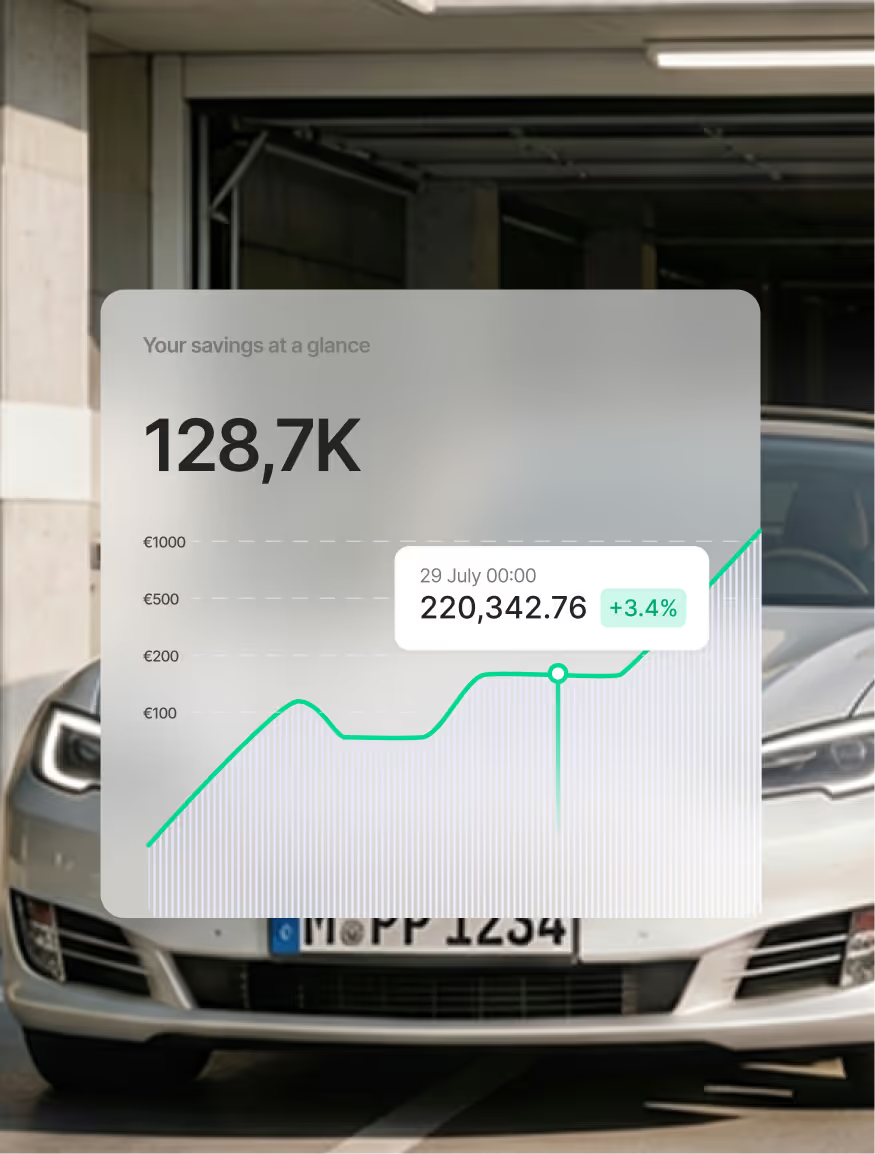
Parking areas and parking transactions are recorded, managed and analysed via (live) dashboards. Payments can be viewed in the tool as well. Operators also have an up-to-date overview of all their parking areas and their occupancy, can define different tariffs such as day tickets or hourly tickets, and can link their offers to various tourism cards and discounts. Parking permissions can also be issued digitally, which makes managing access for employees, suppliers and repair work considerably easier and allows free parking for specific groups or individuals. Optimising the parking processes lets operators concentrate on running the mountain lift.
Benefits for cableway guests
A fast and convenient parking process
The various groups of visitors benefit from digital parking management solutions too. Finding a space is made easier by a smooth traffic flow without barriers, and payment by cashless and contactless options such as NFC – which means considerably less effort when parking. Visitors can manage their stay even more easily through a parking app such as EasyPark or Parkster, which simplifies the parking process further and makes it quicker still. Because digital parking management makes parking tickets redundant, there is no ticket to lose – sparing guests the high charges that come with a lost ticket. All of this adds up to a considerably more pleasant parking experience.
More time
Hand in hand with faster, more convenient parking comes what the mountain visitor is actually interested in: more time. Because there are no queues at the entrance or exit, at the pay machines or at the till, and the time spent parking and on related activities such as payment is reduced, visitors have more time to enjoy nature and the mountains. Guests take away memories of beautiful alpine experiences rather than of drawn-out parking procedures.
{{contact}}
Conclusion
Satisfied guests come back – that much is well known. Keeping customers satisfied takes, among other things, effective parking concepts and parking management for mountain lifts, in order to cope with the demand and make full use of the potential of the parking areas. The parking experience contributes to the overall experience of the cableway and the mountains, of the holiday and thus of the entire tourism region. That way, a positive parking experience benefits not only the mountain lift operator but every other tourism business in the region as well.

Marketing Team
We are shaping the mobility revolution. As the voice of Peter Park, we share insights about digital parking space management and smart city solutions — for a world without barriers.