Parking space management costs time and money — here's how to change that!

According to a survey by the Heidelberg Institute for Energy and Environmental Research (Bergk et al. 2022), the monthly costs per parking space alone are between 104 and 193€. Extrapolated over the year, this is between €1,248 and €2,316 per parking space. With a parking area of 100 parking spaces, this can be up to 231,600€ per year. The same report states that typically only around eleven percent of the costs mentioned can be offset by charging parking fees. In our parking area example with 100 parking spaces, that is 25,476€. Annual costs of 206,124€ remain uncovered.

Example calculation for a parking lot with 100 parking spaces, extrapolated to one year:
- Annual costs per parking space: 193€ * 12 months = 2,316€
- Total annual costs for 100 parking spaces: 2,316€ * 100 = 231,600€
- Compensable through parking fees: 11% * 231,600€ = 25,476€
- Remaining total annual costs: 231,600€ - 25,476€ = 206,124€
These figures show that owners must find ways to reduce running costs related to their parking space while efficiently exploiting the full revenue potential. In this blog, we show where parking space management costs time and money and how you can easily change that.
{{cta}}
Where parking space management costs time and money
Anyone who owns parking space knows that there is a lot of organization behind every space. Especially where many different user groups come together, effort and costs quickly add up. The biggest cost drivers are always the same:
Not everyone who parks should be allowed to do so. Without regular checks, your parking space is quickly full of third-party parkers and the actual users, such as customers or employees, search for a parking space for a long time. In the worst case scenario, they won't find one. But control means effort: You need personnel or a technical system. It is therefore all the more important that the control works without gaps, because only then will your space remain free of third-party parkers.
- parking space management
Anyone who actively cultivates their land can often generate significantly more income, which noticeably reduces running costs — but many are not yet exploiting this potential today. The reason: charging parking fees is often complicated and takes a lot of time.
- Managing parking permits
Most parking spaces are used by many different groups: customers, employees, suppliers, service providers — some should park for free, others at reduced rates and still others on a regular basis. That sounds simple, but requires enormous administrative work: issue authorizations, manage employee IDs, assign tariffs.
- High costs and manual effort due to traditional parking systems
Control, management and parking permits require a system and traditional solutions are usually expensive, complex and inflexible:
- Staff-based systems Such as ticket issuance or checks require permanent deployment of personnel on site. They either hire additional staff or tie up capacities from their core business. Both are inefficient, prone to errors, and 24/7 monitoring is therefore not guaranteed. The result: gaps in control and as a result third-party parkers, non-payers and annoyance.
- Barrier systems Although they create continuous management without additional personnel, they are expensive to buy, maintenance-intensive and susceptible to faults. If the barrier fails, the parking lot is suddenly uncontrolled and valuable income is lost. Apart from employee passes, parking barriers also do not offer an efficient way of offering individual parking rates to different user groups.
- Soil sensors In turn, they are technically demanding and expensive, as each individual parking space requires its own sensor. They are constantly exposed to weather and stress (vehicles that drive over them). Although they recognize whether a parking space is occupied, they can neither charge a parking fee nor automatically track parking violations. The latter remains the responsibility of your personnel.
- Communication costs
“I've lost my parking permit for employees.” — “How long can I park here free of charge? ” — “Have I really parked too long? ”
Such concerns reach you every day by telephone, e-mail or in person. Especially with large areas and many users, there is a constant need for communication, which ties up valuable resources.
- Ongoing operating costs
Whether underground parking, parking garage or outdoor space: There are always certain costs. This includes:
- Building maintenance and lighting in car parks and underground car parks
- Repairing road damage, markings or potholes
- Garden maintenance for outdoor areas
- Electricity costs for lighting
These posts can hardly be avoided, not even with an efficient parking system for control and management. It therefore remains all the more important to reduce all avoidable additional costs in parking space management.
How digital parking space management can help
Digital parking systems using Number plate recognition (ANPR/ALPR) Start right where traditional parking space management reaches its limits. They reduce manual effort, ensure 24/7 control and enable management that is efficient, flexible and economical at the same time. This is how digital parking space management helps:
- Complete, reliable parking space control — completely without personnel
The license plate scanners of digital parking systems automatically record every incoming and outgoing vehicle, 24/7, 365 days a year and in all weathers. This means that your parking area is checked completely and reliably.
- Efficient and easy management
With digital parking space management, management also becomes a matter of course: parking times are recorded seamlessly and automatically, the license plate serves as a parking ticket and parking fees can be easily paid using various payment methods (at local parking machines, with a smartphone,...). The monthly billing costs are also largely eliminated, as these are covered by the provider of the digital parking system.
- Flexible allocation and management of parking permits
Flexibility is another advantage. Digital solutions enable individual rules and parking rates for various user groups. You can either grant these parking permits yourself with just a few clicks in our online dashboard or enable your parking users to activate themselves through verification. Everything goes through the license plate — quickly, transparently and with minimal administrative effort.
- Put an end to expensive, fault-prone systems
In addition to relieving organizational burdens, a license-based parking system also saves you on purchase and ongoing operating costs. Many providers — such as Peter Park — cover the hardware costs in full. The usual expenses for maintenance, repairs and faults are also largely eliminated. Cameras and software are low-maintenance, scalable and reliable, keeping running costs to a minimum.
- Less communication effort
When it comes to digital parking space management, most typical queries are resolved by themselves. Lost parking permits, for example, are no longer an issue — the license plate serves as a unique authorization, without any physical evidence. In addition, the provider of the digital parking system usually acts as a point of contact for parking users. As a result, questions are automatically addressed to him and not to you anymore. This significantly reduces your communication costs.
{{simulation}}
What costs arise with which parking system?
The costs of a parking system are not just the purchase. What matters is what is added over the years in maintenance, staff and downtime:
- Staff-based enforcement: Hardly any purchase costs, but ongoing staff costs. Round-the-clock enforcement is not possible this way.
- Barrier system: High purchase costs, ongoing maintenance and repairs. If it fails, the site is uncontrolled and revenue is lost.
- Ground sensors: One sensor per space, which means high costs for large sites. Checking for violations remains a task for staff.
- Licence plate recognition: Cameras only at entrances and exits, few wear-prone parts and no enforcement by staff. With providers such as Peter Park, there are no hardware costs.
The comparison of parking systems shows how the systems perform in detail.
What does it cost to do nothing?
A parking site without management is not free of charge. The costs of upkeep, lighting and care are incurred regardless. According to ifeu (Bergk et al. 2022), a parking space in cities costs between €1,248 and €2,316 per year. On top of this come follow-on costs that do not appear in any calculation:
- Unauthorised parkers occupy spaces that customers, guests or employees then lack. This can cost revenue.
- Untapped revenue: Sites that stand empty at night or at weekends could bring in additional revenue.
- Internal effort: Complaints, queries and towing away illegally parked vehicles take up time that is lost to the core business. More on this in the article Illegal parking on private car parks.
How to calculate your savings potential
A few details are enough for an initial estimate:
- Record current costs: What do staff for enforcement, maintenance and repairs of the existing system cost per year?
- Review revenue: What parking fees do you collect today, and how many spaces stand empty at which times?
- Assess downtime: How often was the site uncontrolled in recent years, for example because of a broken barrier?
- Compare: With a digital system, these figures are set mainly against the ongoing system costs.
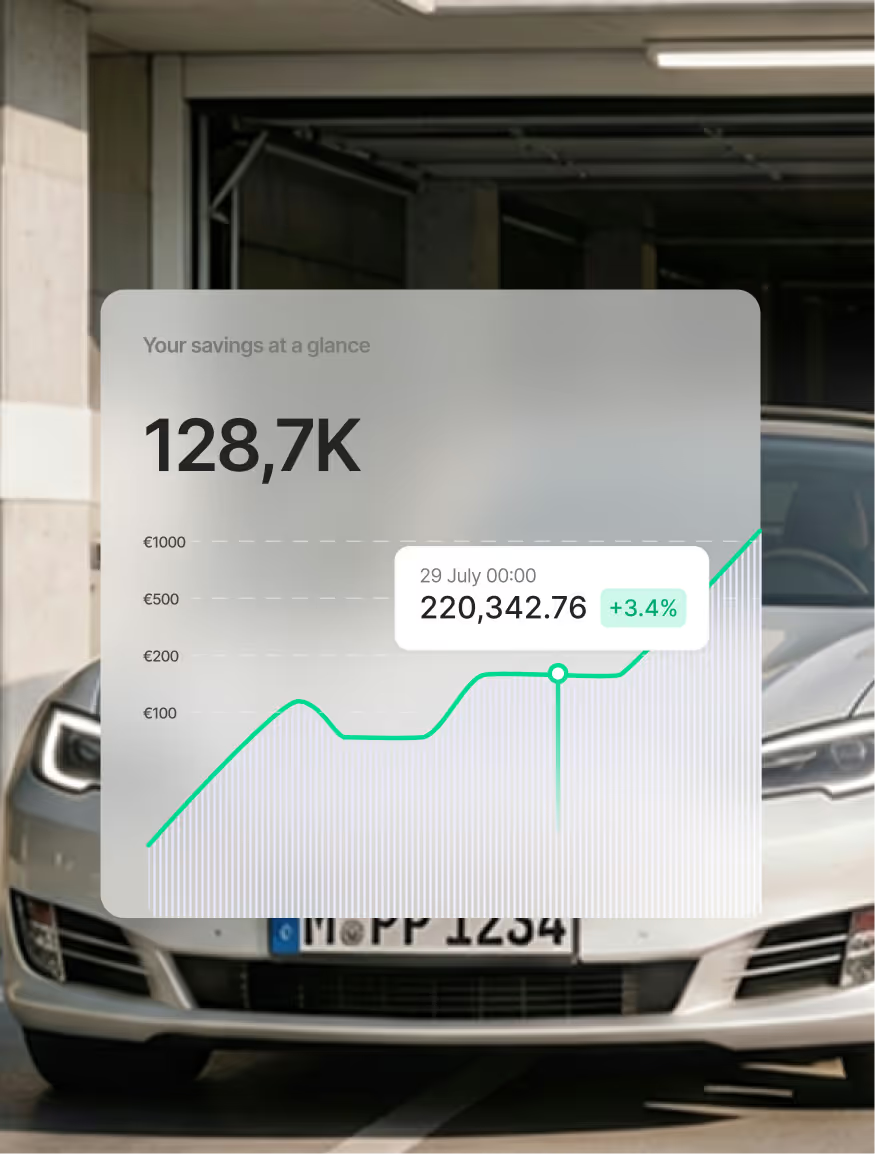
The savings calculator does this calculation for you: you answer a few questions and see how much you can save with a digital parking system. You can read how the introduction works in the article Introducing parking management.
Reduce costs, generate real added value
Parking spaces are still a significant cost factor for companies — but that can be changed. License plate-based parking systems automate central processes, thus reducing effort and costs and offering many other benefits. Anyone who uses a digital solution today turns their parking space into a real asset — efficient, stress-free and profitable.
Bergk, F., Schreiner l. & Dünnebeil, F. (2022). Cost of parking space. Heidelberg Institute for Energy and Environmental Research (ifeu), summary of ad hoc advice for the Baden-Württemberg Ministry of Transport, online at https://www.klimaschutz-bewegt.de/wp-content/uploads/02_Kosten_Parkraum_ifeu_Zusammenfassung.pdf [accessed 28.11.2025].

Marketing Team
We are shaping the mobility revolution. As the voice of Peter Park, we share insights about digital parking space management and smart city solutions — for a world without barriers.
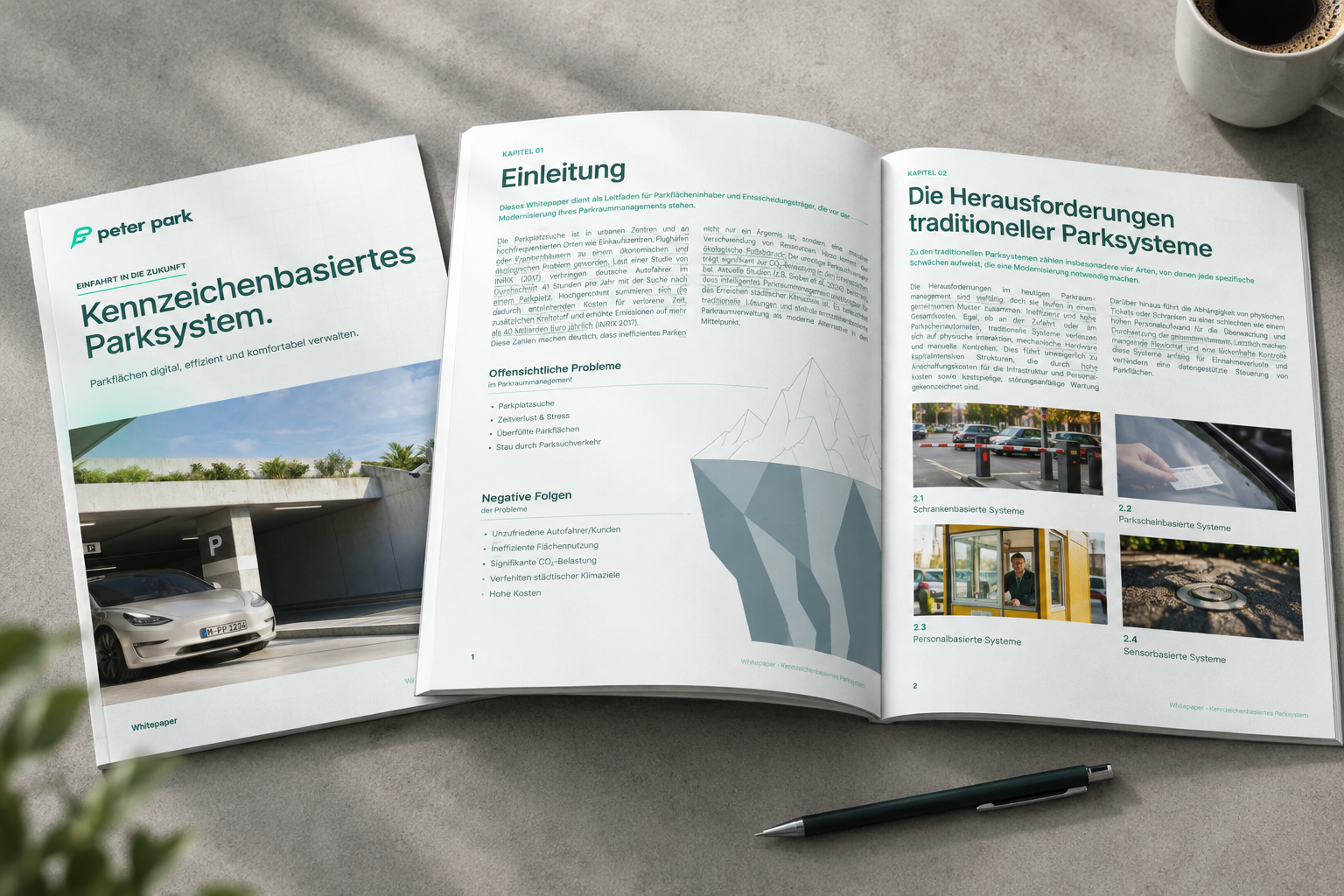
How licence plate-based parking systems work and what operators should consider when switching.
Download whitepaper