Briefly explained: What is behind license plate scanners & ANPR?

What is behind automatic licence plate recognition, ALPR and ANPR?
Car park management is currently changing. Modern licence plate scanners are replacing barriers, parking tickets and parking discs. The technology is simple: vehicle licence plates are captured on entry and exit in a data protection compliant way by a licence plate scanner. Operators manage their parking site conveniently online and, for example, register authorisations for long-term parkers in just a few clicks.
However, anyone considering the introduction of licence plate based parking management or enforcement will inevitably come across terms such as:
- Automatic License Plate Recognition (ALPR)
- Automatic Number Plate Recognition (ANPR)
- Automatic Vehicle Identification (AVI)
- Car plate recognition (CPR)
These terms and abbreviations all refer to one and the same technology. In German, it is also often called automatische Nummernschilderkennung, automatische Kennzeichenerfassung or automatisierte Kennzeichenkontrolle.
How does automatic licence plate capture work?
Parking management solutions such as the Peter Park System are smart Internet of Things technologies. Cameras detect whether a licence plate is in their field of view and only take a photo in that case. Who is driving the car and who is sitting in it cannot be identified. With the help of artificial intelligence, the system reads the licence plate, stores it together with the vehicle's entry and exit times and calculates the parking duration.
What else is part of digital parking management?
The practical thing about digital parking enforcement is that it requires very little hardware on site: all that is needed are signs that point out the data protection compliant licence plate recognition and explain the applicable rules, plus a camera that scans licence plates at the entrance and exit. And a maximum parking period can already be enforced, because everything else runs remotely and is software-based.
In some cases, even paid parking management is possible with this minimal equipment: drivers then simply pay for their stay by mobile on their smartphone.
Car park operators who want to offer their customers further payment options additionally install payment machines so that drivers can also pay on site by card or in cash.
{{cta}}
How does it differ from parking sensors?
Unlike parking sensors, which have to be installed and maintained in every single space, it is sufficient to place licence plate scanners at entrances and exits. Another advantage is that parking enforcement using licence plate capture works without enforcement staff, as violations can be recorded and followed up automatically. With sensors, by contrast, enforcement staff and paper penalty notices are still required. When a parking sensor reports, an enforcement officer has to catch the offender quickly before the car has left the car park. Licence plate scanners, on the other hand, capture almost all vehicles without gaps.
How the OBI store in Bremerhaven keeps its spaces free for customers
Visitors to nearby events often occupied the spaces at the OBI store in Bremerhaven, which affected the store's visitor numbers and caused frustration among customers. Using parking discs did not achieve the aim of keeping unauthorised parkers away.
In August 2023, the OBI store introduced the digital parking management system from Peter Park. Now licence plate scanners automatically capture all licence plates of cars entering and leaving, in a data protection compliant way. The system automatically checks whether the vehicles comply with the maximum parking period or not. If drivers who are not customers of the OBI store exceed the maximum parking period of two hours, they receive a request to pay an increased usage fee.
As a result, the site is no longer attractive for unauthorised parkers who want to park for longer than two hours. More spaces are available for OBI store customers, which ensures a relaxed shopping and parking experience. If a visit to the DIY store takes longer than two hours, customers can have the free maximum parking period extended in the store.
How does a parking session with licence plate recognition work?
For drivers, a car park with licence plate recognition feels like a completely normal car park, just without a ticket and without waiting at the barrier. Behind the scenes, the process runs in five steps:
- Entry: The camera at the entrance detects that a licence plate is coming into its field of view and captures it together with the time.
- Parking: The vehicle parks as usual. Parking ticket, barrier and parking disc are no longer needed.
- Paying or being authorised: Depending on the site, drivers pay by entering their licence plate at the payment machine, online or via app. Alternatively, their licence plate is registered as authorised, for example for employees, long-term parkers or hotel guests.
- Exit: The camera at the exit captures the licence plate again. The system calculates the parking duration and checks it against the payment, the authorisation or the maximum parking period.
- Follow-up: Only if the rules of the site were not observed is the violation followed up. Anyone who parks correctly does not notice the system at all.
What do car park operators use licence plate recognition for?
The same technology covers very different tasks. The most common use cases are:
- Enforcing a maximum parking period: Supermarkets, DIY stores and furniture stores keep their spaces free for customers, like the OBI store in Bremerhaven with a maximum parking period of two hours.
- Charging parking fees: The parking duration is recorded to the minute, and drivers pay by entering their licence plate. More on this in the article on parking management.
- Managing authorisations: Long-term parkers, employees or guests are registered online in just a few clicks, so paper parking permits are no longer needed.
- Using sites for multiple purposes: A supermarket can, for example, rent out its car park to residents at night and keep it free for customers during the day.
- Analysing occupancy: Because every entry and exit is recorded, operators can see in the software when their site is full and how long vehicles park on average.
Licence plate recognition, barrier or sensor: which fits when?
Which system makes sense depends on the site and the goal. A brief overview:
- Barrier: Makes sense if unauthorised vehicles must not enter the site under any circumstances. On the other hand, it is expensive to purchase, maintenance-intensive and can cause tailbacks at peak times. If it fails, the site is uncontrolled.
- Parking sensors: Show whether an individual space is occupied. However, every space needs its own sensor, and checking for violations remains a task for staff.
- Licence plate recognition: Cameras are only needed at entrances and exits. The system records parking duration, payment and authorisation automatically and works without enforcement staff.
You will find a detailed comparison with all the pros and cons in the comparison of parking systems and in the article Barrier or barrier-free parking system.
What does a parking site need?
For licence plate recognition, a site does not need to be rebuilt. Three points matter most:
- Clear entrances and exits: Every vehicle must drive past a camera. The fewer access points a site has, the fewer cameras are needed.
- A suitable location for the camera: The camera needs a clear view of the licence plates. Thanks to infrared lighting, it also recognises licence plates at night.
- Signage: Signs at the entrance point out the licence plate recognition and explain the applicable rules.
The article Costs in parking management shows how much such a system costs compared with a barrier and staff.
Managing parking efficiently and with little effort using ALPR
Only a few components are needed for parking management with ALPR-based solutions; wear-prone components such as barriers and sensors are not required. As a result, parking management systems based on ANPR generate only low purchase and maintenance costs. At the same time, digitalisation and automation reduce staffing effort. Solutions that, like the Peter Park System, are based on automatic licence plate recognition therefore offer all-round efficient parking management.
Do you still have questions about ANPR/ALPR? Contact us for a no-obligation consultation.

Regina Groß
PR manager with a passion for IT and digitization who loves to translate complex issues into understandable stories.
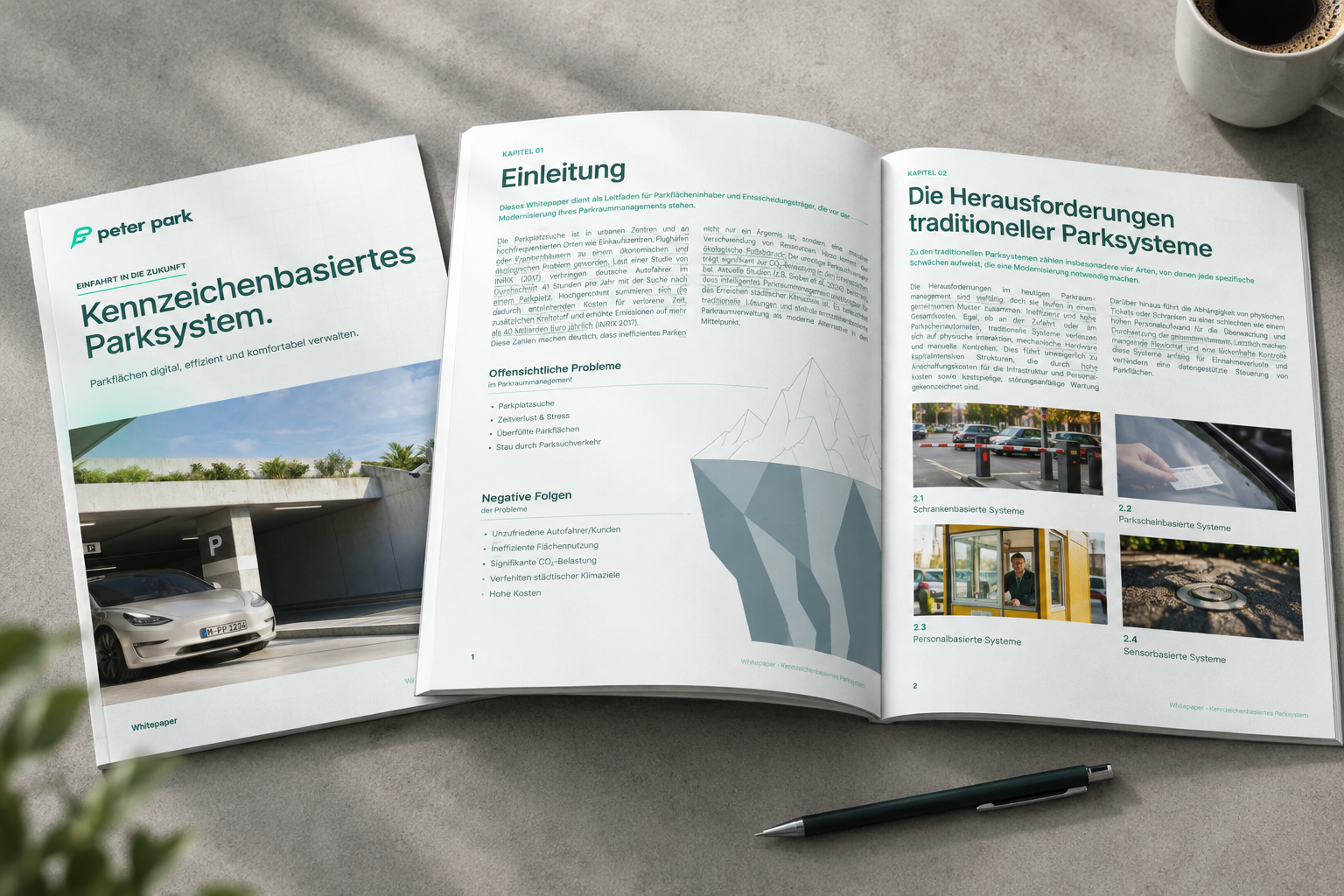
How licence plate-based parking systems work and what operators should consider when switching.
Download whitepaper