How digital employee parking spaces become a benefit

Easy management of employee parking spaces
Efficient parking space management is an essential part of modern workplace infrastructure. Employee parking spaces not only improve operational processes in the long term, but can also increase employee satisfaction. When designing these parking spaces, companies should consider the selection of a suitable parking space management system from the outset to ensure that the parking spaces really benefit employees.
Are employers required to provide parking spaces for employees?
In general, German companies are not obligatedto provide parking spaces for their employees. There is an exception for companies that cannot be reached by public transport, such as in remote villages and undeveloped valleys. In this case, employees are entitled to a company parking space. The number of parking spaces to be provided depends on the Garage and Parking Ordinance (GastElV) of the respective federal state.
Regulation for new commercial real estate
Care should be taken when building a new commercial property. Under certain circumstances, a new building may have requirements to create new parking spaces. Such requirements aim, for example, to reduce the lack of parking spaces in certain regions. In the case of a new building, the Solar obligation And the Mandatory e-charging stationswhich are to be considered.
Regulation in employment contracts
The provision of parking spaces for employees may also be specified in employment contracts. If a company grants an employee a parking space in an employment contract, it must also provide the appropriate parking space.
Voluntary offering of employee parking spaces
Companies can also voluntarily choose to offer employee parking spaces. They can use the following criteria for their decision:
- expenses
Employee parking spaces must be affordable for the company — regardless of whether parking space is rented or built in-house. Parking spaces owned by companies cost less in the long term, while rented parking spaces are cheaper in the short term. In addition, the repair, maintenance and servicing of employee parking spaces must also be included. Barriers and their repairs, downtime and inspection personnel in particular often cause high costs. Here can a License plate-based solution Reduce costs in the short and long term, as wear, maintenance and repair costs are reduced and also increase the efficiency of parking space management. Peter Park offers this technology.
- Employee advantage
It makes sense to have current employees fill out a short survey to determine the need for parking spaces and to ask about an ideal travel situation. In this way, the needs of employees can be addressed well.
With employee parking spaces, companies can position themselves as attractive employers and stand out from competitors in the competition for talent. At the same time, they may create an additional incentive for long-term employees to remain loyal to their employer. Employee parking spaces can be a criterion for choosing an employer, especially for people who come from small towns with poor transport connections or even for employees with families. Not to forget the employee parking space as a status symbol, which is still very relevant today.
- company values
Employers should ask themselves whether employee parking spaces are in line with corporate culture. To do this, it makes sense to look at the company's mission, vision and values and to include them when deciding for or against employee parking spaces. To make these points clearer, here are two examples to compare:
- A medium-sized company is located in a less well-developed industrial zone of a medium-sized German city. Various benefits (company cars and family-friendly employee events) and the way employees work (no meetings after 17:00 and flexitime) show important values for the decision. The focus here is on comfort, family-friendliness and effectiveness. Employee parking spaces make sense for this company.
- A small, modern start-up in an urban area has defined sustainability as a central corporate value. The offices are well connected by public transport. Employee parking spaces are of little use to this company.
- A medium-sized company is located in a less well-developed industrial zone of a medium-sized German city. Various benefits (company cars and family-friendly employee events) and the way employees work (no meetings after 17:00 and flexitime) show important values for the decision. The focus here is on comfort, family-friendliness and effectiveness. Employee parking spaces make sense for this company.
{{contact}}
Manage employee parking spaces efficiently
To ensure that employee parking spaces are actually available to employees and are not occupied by third-party parkers unrelated to the company, employers need a parking management system. There are various solutions on the market. Digital, barrier-free systems are particularly suitable for companies whose core business is not parking space management. This includes Peter Park's solution, which is inexpensive to buy and operate, as almost no components susceptible to wear are used on the surface. The solution works with privacy-compliant license plate recognition at entry and exit.
The system checks whether parking people are authorized to use employee parking spaces or not. Third-party parkers receive a contractual penalty from the service provider, which makes the parking space unattractive for them and remains free for employees again from then on.
Employers do not receive any personal information about parking people. Instead, they offer their employees digital parking tickets for a fee via an online shop operated by the service provider or allow them to park for free. Thanks to this solution, the company has virtually no administrative costs. At the same time, it receives data protection-compliant evaluations of its own parking areas and can thus make better decisions about the future demand for employee parking spaces, for example.
This is how the Scheibbs State Hospital manages its employee parking spaces
In hospitals, every second sometimes counts. Employees work in shifts and staff changes also take place outside public transport operating hours. Clinics therefore normally provide sufficient parking spaces for their employees. Barrier-based parking systems, which cause backlogs in the event of large crowds and can therefore block access for ambulances, may not be useful there. At the Scheibbs Regional Hospital in Lower Austria, a barrier system had been in use since 2009, but its maintenance and repairs caused high costs. If the plant was down, revenue was lost because parking people were able to drive on and leave the parking area uncontrollably. The Scheibbs Regional Hospital in Lower Austria therefore introduced Peter Park's digital, barrier-free and ticket-free solution in April 2023. Since then, not only employees, but also visitors and patients have been parking seamlessly in the parking areas of the healthcare facility. Thanks to the solution, the hospital is able to offer different parking conditions to different user groups.
Even the Arberland Clinic in Viechtach Relies successfully on the Peter Park system.
How do you allocate employee parking spaces fairly?
If there are fewer spaces than interested employees, clear rules are needed. These criteria help with allocation:
- Working hours: Employees who work shifts or outside public transport operating hours are particularly dependent on a parking space.
- Journey: Employees from small towns with poor transport links often have no alternative to the car.
- Car sharing: Those who give others a lift can be given priority. This saves spaces.
- Attendance: Those who are only in the office on certain days do not need a fixed space, but an authorisation for those days.
- Ask about demand: A short survey among employees shows how many spaces are really needed.
It is important to make the rules transparent and to review them regularly. Analyses of site occupancy help with this.
Employees, visitors, suppliers: different rules on one site
On many parking sites, it is not only employees who park. With a licence plate based system, separate rules can be set for each group:
- Employees park free of charge or buy a digital parking ticket, and the authorisation is linked to the licence plate. Lost parking permits are a thing of the past.
- Visitors, customers and patients park, for example, with a free maximum parking period or pay a parking charge.
- Suppliers and service providers are registered as authorised if they regularly need access to the site.
Employers assign authorisations in just a few clicks in an online dashboard, or employees activate access themselves through verification. You can read more about the costs and effort in the article Costs in parking management.
Introducing digital employee parking: how to proceed
- Determine demand: How many employees come by car, and at what times?
- Set rules: Who may park, on what terms, and which rules apply to visitors and suppliers?
- Set up the system: Cameras at the entrance and exit capture the licence plates, and signs explain the rules.
- Inform employees: Explain how the authorisation works and whom they can contact with questions.
- Evaluate and adjust: Occupancy shows whether the number of spaces is right or whether rules should be changed.
The article Parking management at hospitals shows how clinics with shift work and many user groups organise their sites.
conclusion
Companies are generally not required by law to provide parking spaces for employees. However, it may be useful to offer employees parking spaces. Costs, requirements and company values play a role in the decision. Digital, barrier-free parking space management solutions such as the Peter Park System are available for efficient, low-effort administration.

Marketing Team
We are shaping the mobility revolution. As the voice of Peter Park, we share insights about digital parking space management and smart city solutions — for a world without barriers.
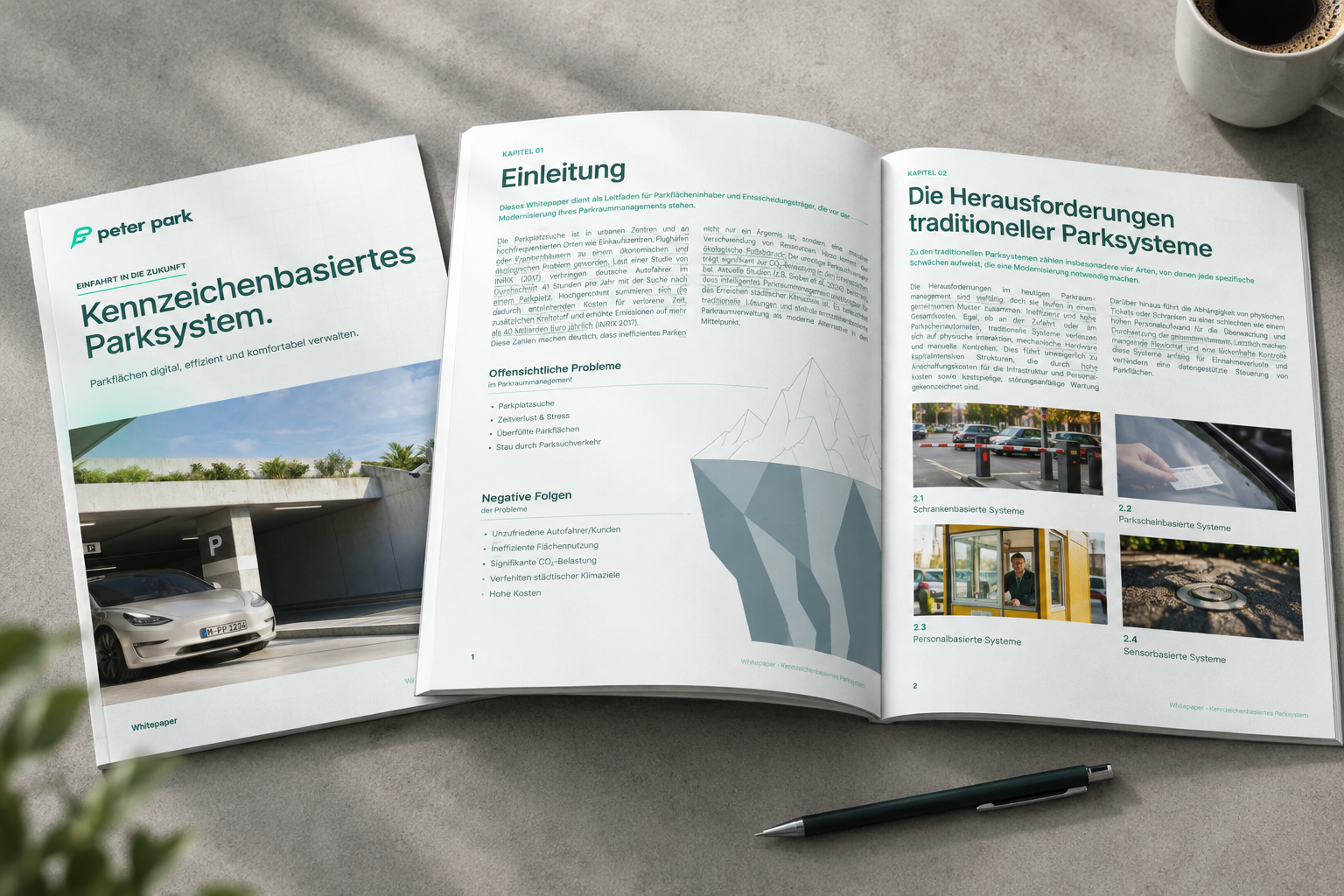
How licence plate-based parking systems work and what operators should consider when switching.
Download whitepaper