From car park to Mobility Hub: How to prepare your car park for new mobility

A car park becomes a Mobility Hub when you integrate EV charging stations, car sharing or e-scooters and link everything digitally. The basis is barrier-free licence plate recognition, which brings parking, payment and partner services together in one process.
What is a Mobility Hub?
A Mobility Hub bundles various mobility services in one place. These include parking spaces, sharing models, micromobility, EV charging stations and a connection to public transport. Users can combine these services flexibly.
The question of which means of transport to use is no longer just: "Car or train?" A typical journey today looks like this: Travellers drive to the hub by car and continue by suburban train. Commuters cover the last stretch by e-scooter or on foot. For this to work smoothly, booking and payment for the various providers must be linked.
Why does the mobility transition need new nodes?
Electric vehicles and car sharing are changing urban traffic. They need charging stations and dedicated parking spaces. The space for this is already scarce in many city centres.
The consequences are visible: Cars parked at the roadside obstruct pedestrians and cyclists. A lack of parking space creates traffic searching for parking, which pollutes the air and the environment. At the same time, demand for alternatives is growing. Rising petrol prices and greater environmental awareness are leading many people to think more critically about buying a car.
For the switch to succeed, the services must be linked. This relieves traffic and makes sustainable forms of mobility convenient. Sustainable mobility cannot be imposed. It has to convince through a customer-friendly offer and smart use of existing resources.
How does an existing car park become a Mobility Hub?
In city centres, there is rarely room for new space. Nor is it necessary. By using existing car parks efficiently, Mobility Hubs can be created without major infrastructure projects. With smart parking management, any car park can become a Mobility Hub, tailored to the needs of the surrounding area.
The key lies in digitalising car park management. One example is empty supermarket car parks and office car parks. Until now, they have often been closed off by barriers outside business hours. Managed digitally, they can be opened up at these times and link mobility services inside and outside the city.
For operators, this is an opportunity. They meet the expectations of different user groups and create new revenue potential. The car park then appeals equally to commuters, residents and retail customers.
Which services belong in a Mobility Hub?
Which building blocks make sense depends on the location. The following services make a car park attractive even for people without their own car.
EV charging stations
Users of e-cars, e-bikes and e-scooters often find too few charging stations. For certain buildings, the Gebäude-Elektromobilitätsinfrastruktur-Gesetz (GEIG, German Building Electromobility Infrastructure Act) requires charging infrastructure in the parking spaces. Operators who upgrade their car park now are prepared for rising demand.
Car sharing
More and more people use car sharing instead of owning a car. This does not automatically reduce demand for parking spaces. Car sharing vehicles also need space. Until now, sharing fleets have often been faced with closed barriers. Barrier-free parking technology allows more parking spaces to be used for car sharing.
Micromobility and public transport connection
E-scooters, electric mopeds and bicycles close the gap on the last stretch. Partners through which users pay parking costs by app, book car sharing or rent an electric moped are increasingly becoming standard. Parking technology must be able to handle these requirements.
Parcel and pick-up stations
People who are out and about during the day often miss parcel deliveries. Parcel lockers are then the most convenient solution for collecting orders at any time. For operators, they expand the offer for residents, regardless of whether they own a car. This creates further revenue potential.
{{cta}}
- EV charging stations: For users, charging while parking. For operators, preparation for rising demand, mandatory for certain buildings under the GEIG.
- Car sharing: For users, a car without buying one. For operators, additional occupancy of parking spaces.
- Micromobility: For users, flexibility on the last stretch. For operators, new user groups without their own car.
- Public transport connection (P+R): For users, predictable commuting with a linked ticket. For operators, higher footfall and occupancy data.
- Parcel locker: For users, collecting orders at any time. For operators, an additional service and source of revenue.
What technology does a Mobility Hub need?
A Mobility Hub needs a system that links the services and makes them easy to use. Parking systems with licence plate recognition and without barriers deliver exactly that. They combine minimal hardware with cloud-based software. The entire parking process runs digitally, and the car park is monitored around the clock.
On entry and exit, a camera records the licence plate in compliance with the GDPR. The parking management software links the parking session and payment in the background. How recognition works in detail is explained in the article on licence plate scanners (ALPR/ANPR).
This has several advantages for operators:
- Less hardware: Barriers, sensors, enforcement staff and paper tickets are no longer needed.
- Lower costs: Digital systems are cheaper to purchase and maintain and less prone to breakdowns.
- Robust: The licence plate scanner is mounted several metres above the roadway and is thus protected against vandalism. A 24/7 maintenance service as with barriers is not necessary.
- Automatic enforcement: Unlike parking sensors, licence plate recognition monitors the maximum parking duration and detects parking violations directly. Patrols of the car park are no longer needed.
- Free flow: Without a barrier, there are no backlogs at the entrance and exit, even at peak times.
Car parks can no longer be viewed in isolation. They are part of digital mobility concepts. Only if the technology reflects this can Mobility Hubs be created without a major financial burden on the federal and state governments.
Practical example: How a digital P+R hub works
In the morning, a commuter drives onto a park-and-ride site on the outskirts of the city. The camera records his licence plate on entry; there is no barrier. He boards the suburban train and covers the last stretch by e-scooter.
In the evening, he drives out again without stopping. The system automatically matches his parking session with the stored public transport ticket and settles the charge. The commuter can plan his journey reliably, and the city centre is relieved of car traffic.
The operator benefits too. The barrier-free flow relieves the entrance and exit at peak times. At the same time, traffic and occupancy data is generated. With this data, mobility and service offerings can be designed to meet demand, for example the number of car sharing spaces or charging stations.
What are the benefits for cities and municipalities?
A Mobility Hub has an impact beyond its own site. Smart traffic management relieves the roads. Alternative mobility services reduce parking pressure in the city centre. A well-developed charging infrastructure makes cities and municipalities attractive to visitors.
The environment also benefits. A wide range of means of transport can lead to fewer cars on the road and new purchases being reconsidered. This reduces CO2 emissions and noise. If existing parking space is used efficiently, on-street parking areas can be converted into cycle paths or green spaces. This improves the quality of life in the cityscape.
Peter Park digitalises car parks for cities and private operators. Parking processes run paperless and without barriers, controlled by parking management software with automatic licence plate recognition.
{{contact}}
Conclusion
A Mobility Hub makes your car park attractive for drivers and for people without their own car. You gain new user groups and revenue streams and remain flexible for future developments. The basis is a digital, barrier-free parking system that connects parking, payment and partner services. This turns a simple car park into a node for the mobility of tomorrow.

Marketing Team
We are shaping the mobility revolution. As the voice of Peter Park, we share insights about digital parking space management and smart city solutions — for a world without barriers.
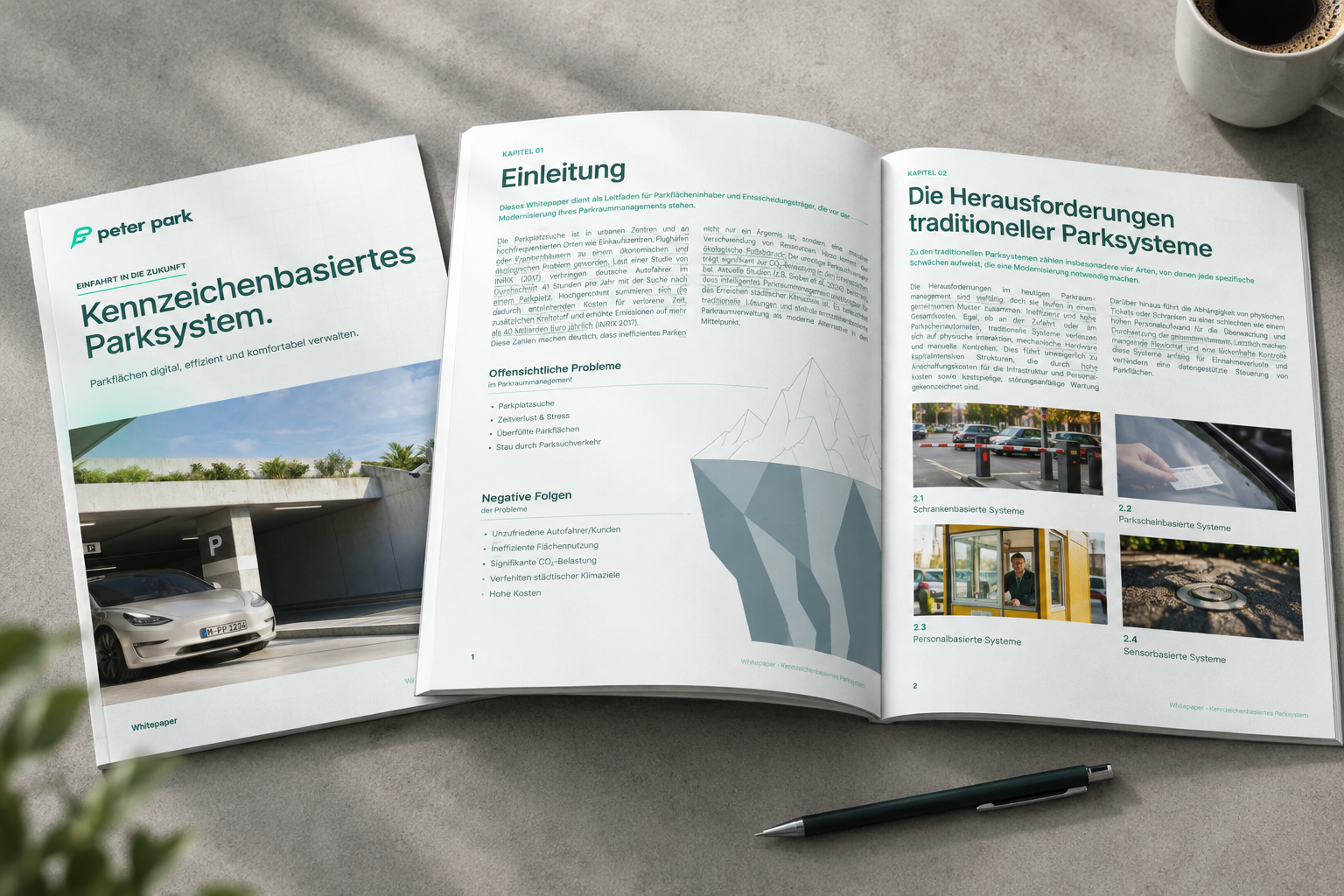
How licence plate-based parking systems work and what operators should consider when switching.
Download whitepaper