Reducing traffic searching for parking: Strategies for towns and municipalities

Towns and municipalities reduce parking search traffic most effectively when drivers know before they set off where a space is free and existing car parks are managed consistently. Digital, barrier-free parking systems with number plate recognition provide the occupancy data for this, keep long-term parkers away and prevent queues at the entrance.
What is parking search traffic and what does it cost?
Parking search traffic refers to the share of total traffic that arises solely from searching for available parking spaces. According to an INRIX study from 2017, drivers in German cities spend an average of 41 hours a year looking for a parking space. This results in additional costs of €896 per driver, calculated from lost time, fuel consumption and additional exhaust emissions.
The consequences do not only affect those searching. Constant stopping and starting increases the risk of rear-end collisions and congestion. Search traffic pollutes the air, creates noise and lowers residents' quality of life. This is particularly noticeable in urban centres and tourist communities. Solutions against parking search traffic are therefore in the interest of all city dwellers and visitors.
Why does parking search traffic arise?
More and larger vehicles
According to the Umweltbundesamt (German Environment Agency), the number of motor vehicles in Germany has risen continuously since 1991. According to the Umweltbundesamt, there were 48.8 million cars on 1 January 2023. Between 2008 and 2023, the stock of motor vehicles grew by 21.1 percent. At the same time, cars are getting bigger: the stock of smaller cars rose by 2 percent in ten years, while that of vans, SUVs and similar vehicles rose by 80 percent. Their share of the total stock grew from 18 percent in 2013 to 29 percent in 2023. Cities therefore need more and often larger parking spaces.
Missing or patchy management
If parking is unlimited in time and free of charge, many people leave their vehicle there permanently. These spaces are then missing for visitors and residents. A maximum parking duration with a parking disc has a similar effect if it is only enforced patchily. Residents' parking spaces are also occupied by others if permits are only checked sporadically. On sites with pay and display, parkers often do without a ticket altogether if there are no regular checks.
Barriers as a bottleneck
Barrier systems do ensure that almost all parkers pay. However, they cause high purchase, maintenance and repair costs. If the barrier is faulty, revenue is lost. Stopping, taking and inserting tickets at entry and exit also creates queues that further prolong the search for a parking space.
The following overview shows how common forms of management affect parking search traffic:
- Free and unlimited: Long-term parkers occupy spaces. This significantly increases parking search traffic.
- Parking disc with maximum parking duration: Enforcement is only patchy. This increases parking search traffic when spaces are permanently occupied.
- Pay and display without regular checks: Parkers do without a ticket. This increases parking search traffic through free long-term parking.
- Residential parking with sporadic checks: Outsiders use the spaces. Residents search longer.
- Barrier system: Queues, maintenance and breakdowns prolong the search at the entrance.
- Digital and barrier-free with number plate recognition: Hardly any hardware and complete recording. This reduces parking search traffic through free spaces, data and free access.
{{cta}}
Which measures help municipalities against parking search traffic?
Municipalities can start at several points. These include improved parking management, parking guidance systems and attractive alternatives to private motorised transport.
Introduce digital, barrier-free parking management
If existing parking facilities are managed efficiently and signposted, visitors drive directly to free spaces. At municipal car parks, multi-storey car parks and underground car parks, a digital system with number plate recognition pays off.
This is how it works: a camera captures the vehicle's number plate on entry. The driver pays via app or at the pay station by entering their number plate. On exit, the system checks the parking authorisation. Operators manage their sites in a web dashboard. Parking apps such as Parkster can also be integrated.
Because there are no barriers, nobody has to stop at entry and exit. This prevents queues. Paper tickets and printed receipts are also eliminated. Non-payers can be tracked almost without gaps. Free long-term parking is therefore no longer worthwhile, spaces become free and search time decreases.
Connect a parking guidance system with real-time occupancy
A digital parking management system continuously provides occupancy data. In combination with a parking guidance system, municipalities direct drivers without detours to sites with free spaces. Occupancy can also be displayed on the municipality's website, in the navigation device or on the smartphone.
Manage tariffs according to occupancy
If a municipality has several car parks and multi-storey car parks, it can control the distribution via prices. The fuller a site is, the more expensive parking there becomes. Cheaper tariffs apply in underground car parks with a lot of free space. With real-time data, prices can not only be set according to average occupancy, but also adjusted dynamically.
Open empty sites to residents
In most cities, car parks are sometimes completely empty. Supermarket car parks are free at night and on Sundays and public holidays, underground car parks of office buildings in the evening and at weekends. At the same time, residents without a fixed space are looking for a place for the night in the evening.
With a digital system, these sites can be opened for residential parking at the supermarket without barriers, pay stations or manual enforcement. Residents buy their digital parking permit via app. Number plate recognition checks whether they comply with the agreed period. This has already been implemented in numerous customer projects. It reduces evening parking search traffic and the need for additional parking space.
Promote alternatives to private transport
Fewer cars mean less search traffic. Municipalities can convert car parks into so-called mobility hubs. There, different mobility services come together, such as park and ride, car sharing, bicycles and local public transport. Dedicated spaces for car sharing vehicles, a better cycle path network and stronger public transport complement this approach.
What role does parking play in the smart city?
There is no generally accepted definition of the term smart city. It summarises concepts that develop processes in the city efficiently, socially and sustainably. Digitalisation supports this. Many cities focus on three areas:
- Mobility and transport: Car sharing reduces the need for private cars. Smart traffic lights adapt green phases to the traffic situation. Stationary traffic is also coming into focus, for example through barrier-free parking, shared mobility services and charging stations.
- Communication: Technical systems exchange data, for example sensors with traffic light control. Online portals simplify contact between citizens and administration.
- Energy efficiency: Solar street lights and controls that detect pedestrians and vehicles save electricity and protect residents and animals.
Today, car parks are usually designed statically for a single purpose, such as "only for supermarket customers". In the smart city, they are to serve several user groups: customers during the day, residents at night, car sharing vehicles and electric cars at charging stations. This only works if sites are managed digitally and automatically. Different uses can then also be billed differently. Without digitalisation, conflicts arise between the groups and the site remains inefficient.
How does digital parking management contribute to the mobility transition?
More and more municipalities are converting roadside parking spaces (on-street) into space for cyclists, pedestrians and green areas. As a result, parking spaces away from the street (off-street) are gaining in importance. Digital parking management makes these sites more efficient to use through dynamic occupancy control.
Additional demand can thus often be met with existing infrastructure. Municipalities do not have to build new multi-storey car parks for lost roadside spaces. This limits soil sealing. Barrier-free, ticketless parking also saves paper and waste. Because queues at the entrance disappear, CO2 emissions directly at the car park also decrease.
Practical examples: How municipalities reduce search traffic
Bodman-Ludwigshafen on Lake Constance: In August 2022, the tourist municipality introduced a barrier-free, digital parking system at four car parks. It was part of a comprehensive project for traffic digitalisation. Previously, search traffic caused congested roads and noise in the village. Arriving visitors did not know where car parks were located, how many spaces were free and how much parking cost.
With the switch, signs at the entrances to the village pointed to the parking options. Occupancy could be viewed on the municipality's website, in the navigation device and on the smartphone. In addition, the municipality adapted its tour programme: guided tours started at the cheaper, less central car parks instead of in the village centre. The result: less search traffic, lower CO2 emissions, and drivers headed for the sites directly without waiting at barriers.
Miltenberg in Bavaria: In the town of Miltenberg, too, a digital parking management system runs on four car parks. It prevents queues at the car parks and saves paper, waste and costs.
{{contact}}
Conclusion
Parking search traffic costs time, increases the risk of accidents and burdens residents with noise and exhaust fumes. Municipalities can significantly reduce it with digital, barrier-free parking management, parking guidance systems and occupancy-based tariffs. Opening empty sites to residents and promoting alternatives such as mobility hubs strengthens the effect. This makes parking management a concrete building block of the smart city and the mobility transition, as Bodman-Ludwigshafen and Miltenberg show.

Regina Groß
PR manager with a passion for IT and digitization who loves to translate complex issues into understandable stories.
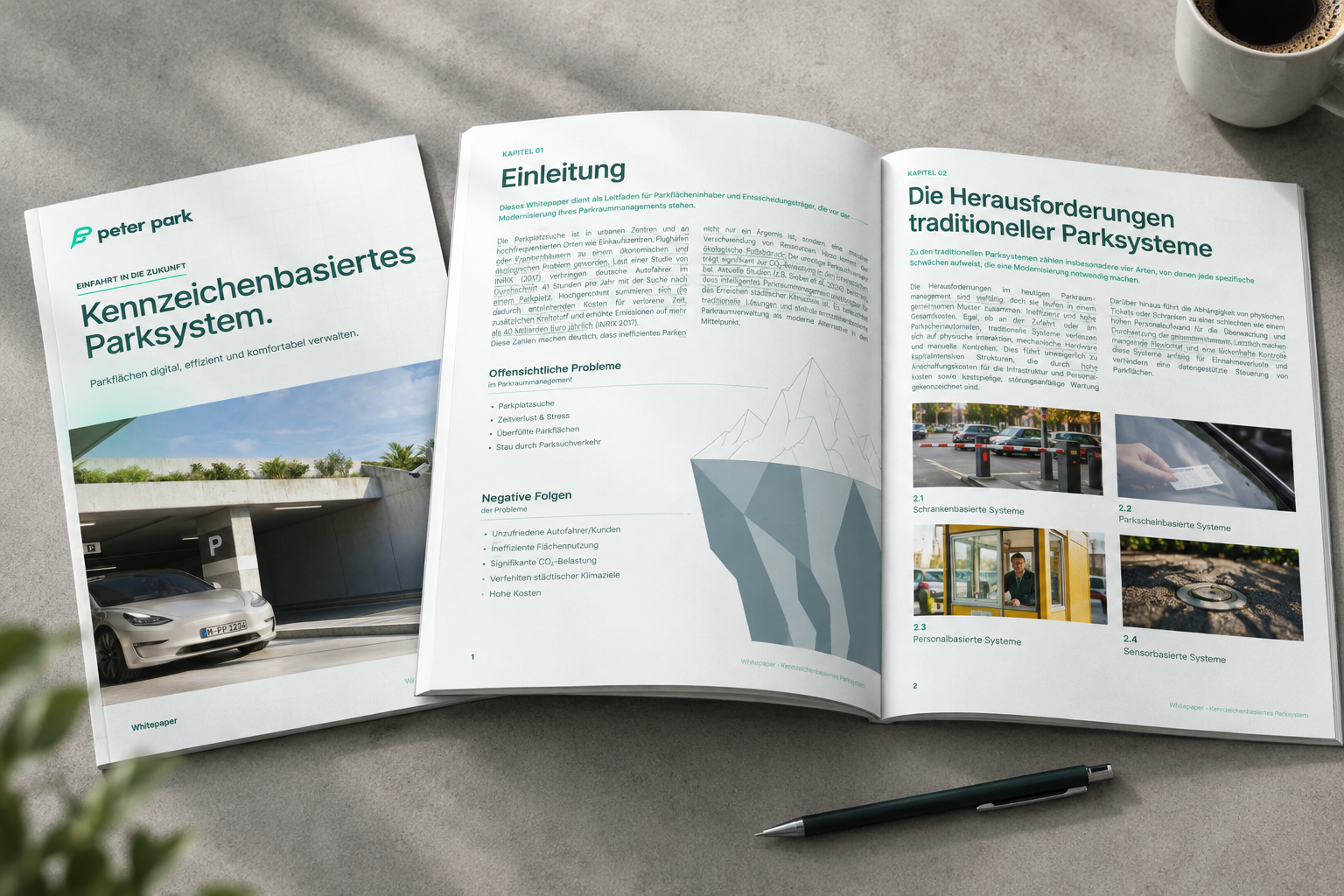
How licence plate-based parking systems work and what operators should consider when switching.
Download whitepaper